
FACES OF CRITICAL CARE
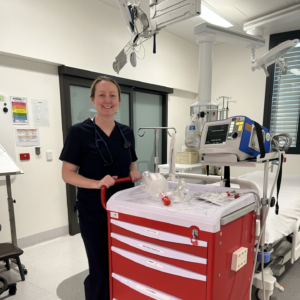
Laura Munckton
ICU Nurse Practitioner
“One where I feel I’ve made a positive contribution to someone else’s day.”
You’ve spent many years in critical care – what has kept you passionate about ICU nursing over time?
A mix of patient acuity & complexity, collegiality among ICU staff both within my organisation and across health services, and the diverse career pathways ICU nursing has to offer from novice RN through to CNS, CNE, ANUM, and Nurse Practitioner.
As an ICU liaison nurse, how do you support patients and teams beyond the ICU environment?
Much of my work is referral based and involves the early review and intervention of inpatients outside the ICU, particularly where a clinical concern has been raised by either the treating medical/nursing team or by the patient’s family members. This might involve providing support and education to staff caring for patients with complex care needs such as a tracheostomy, assisting with difficult vascular access, attending MET calls, facilitating ICU referrals and admissions, or facilitating a staff debrief following a clinical event.
What does a “good shift” look like to you?
One where I feel I’ve made a positive contribution to someone else’s day. That might be helping a nurse with the care and clinical escalation of a deteriorating ward patient, facilitating an urgent patient transfer, advocating for family or next-of-kin to ask questions during MET calls, or providing patient education on risk factors and lifestyle modifications for improved health literacy.
What’s one thing you focus on most when supporting or educating other nurses?
Creating a safe space for learning. I’m a big advocate of psychological safety in the workplace, particularly in healthcare where we’re constantly navigating high-stakes situations. When nurses feel safe to ask questions or admit uncertainty, patient care improves and teams’ function better. So, my focus is on bringing the calm to every interaction so that hopefully nurses feel safe, supported and at ease when reaching out for help.
What’s a moment in your career that reminded you why ICU nursing matters?
Seeing the growing support for ICU nurse practitioner models of care from both hospital executives and state health departments is a great reminder of why ICU nursing matters and the value we all bring each and every day to the lives of our patients, our communities, and our organisations.